
Batch Records That Carry an Approved Sample Into Bulk
A batch record is the document that decides whether the bottle in the carton was made the same way as the sample that was approved. At the sample-to-bulk handover, four things have to be fixed in writing: the formula version, the material lots allowed, the fill and crimp tolerances, and the retention sample that stays behind. For a creator launch, where the drop date is public before production begins, that handover is the moment a small undocumented change turns into a visible problem.
Key takeaways
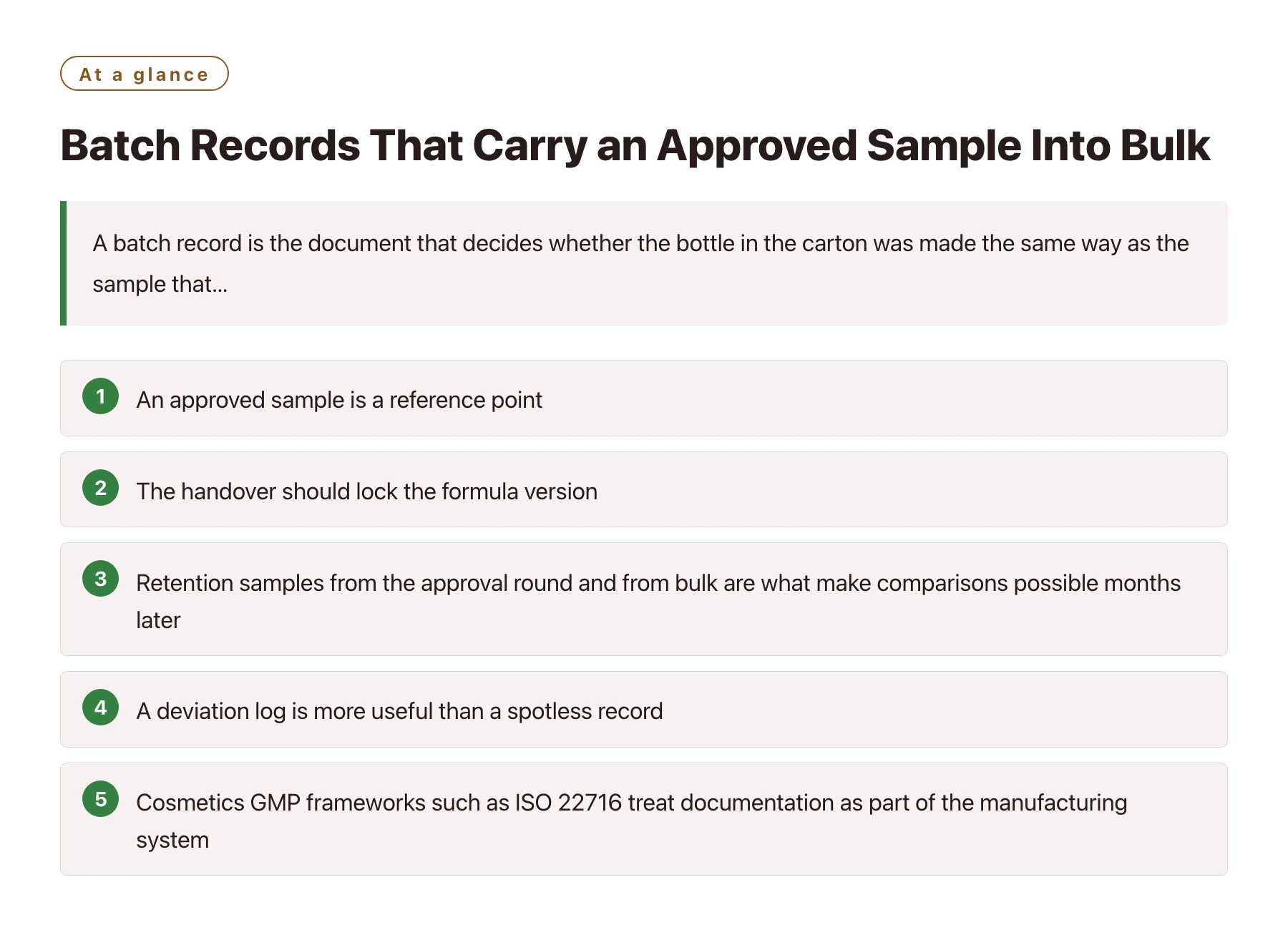
- An approved sample is a reference point, while a batch record is the instruction that makes the reference repeatable.
- The handover should lock the formula version, the permitted raw material lots, fill and crimp tolerances and the retention sample before the first bulk weighing.
- Retention samples from the approval round and from bulk are what make comparisons possible months later, when a reorder is already scheduled.
- A deviation log is more useful than a spotless record, because it shows how a factory handles a change rather than hiding it [1].
- Cosmetics GMP frameworks such as ISO 22716 treat documentation as part of the manufacturing system, not as paperwork added afterwards [2].
Batch records are usually filed under compliance. In practice they are a production subject: they are what a compounding area follows, what a filling line is checked against, and what a brand reads when something smells different from the bottle it approved. The approval sample sits at the centre of that system, but it is a single physical object. The record set is what carries it forward.
This piece looks at the handover from an approved sample to a bulk run, from the perspective of the people running it, and at why a creator-led launch raises the stakes on the same set of documents.
The handover tests the specification, not the sample
There is a quiet assumption in many first orders: that the approved sample is the specification. It is not. A sample is a physical reference; a specification is a written one. Between them sit decisions that are easy to leave open on a bench and expensive to leave open on a line. Which grade of a material is acceptable? How much can the alcohol vary? What fill weight still passes? What happens when a pallet of glass arrives with a slightly different neck finish?
The handover exists to close those gaps while the run is still being scheduled rather than while it is running. A useful handover pack contains the formula version that was approved, an agreed list of material substitutions that do not require a new sample, the fill weight and crimp tolerances, the artwork and decoration that passed, and the retention sample protocol. It is a short pack, but every line in it removes a decision from the shop floor.
If both sides signed an approval sheet, that sheet should say what was approved: the scent, the colour, the fill, the bottle and the closure, each against a tolerance. Where a decision is not written down, the factory will resolve it in the way that keeps the line moving. That is usually the fastest option rather than the one the brand would have chosen. Writing the decision down is how a brand keeps the choice.
A manufacturer that publishes its scope openly, as Xuelei Perfume does, is not automatically a manufacturer with better records. The point of looking at the scope is narrower: it tells you whether development, compounding, filling and packing happen under one roof or across several addresses, because that is what determines how many handovers a version number has to survive.
A reference sample and a retained sample are not the same object
A reference sample is the approved scent, kept under defined conditions and used to compare later production against it. A retained sample is drawn from the production run and stored so that a complaint or a query can be traced back to a specific batch. A first order that keeps one and not the other loses one of two abilities: testing a reorder against the original, or answering a customer question about a particular delivery.
Five gates in a sample-to-bulk handover
- Freeze the formula versionRecord the exact version approved, including solvent, colour or additive, and confirm that the bulk formula is that same version rather than a later revision.
- Agree the material lotsList which incoming lots are acceptable for the run and which differences, such as a tolerated shade shift, do not require a fresh sample.
- Fix fill and closure tolerancesWrite down the fill weight range, the crimp or pump specification, and how many units are checked per hour during filling.
- Draw retention samplesTake samples from the approval round and from bulk, label each with its batch code, and store both under the same conditions.
- Rehearse the deviation pathAgree before the run who is told when something changes, what counts as a stop, and how the decision is written up.
What each record proves, and what it cannot
| Record | What it fixes | What it cannot prove |
|---|---|---|
| Approval sheet | The scent, colour, fill and packaging both sides accepted | That a later batch matches it |
| Formula version log | Which recipe was issued to the compounding area | That the weighing was performed as written |
| Material lot list | Which raw material batches entered the mix | That incoming material was tested on site |
| Fill and crimp record | The checkpoints taken during filling and closing | That every unit on the pallet was inspected |
| Retention sample | A physical reference belonging to one batch | How the product will behave in two years |
Read together, these records describe a chain. Read alone, any one of them overstates what it can show.
Why a creator launch changes the pressure on the same records
A creator-led launch — an influencer drop with a published date — compresses the calendar. The audience knows the date, the countdown is published, and the first shipments are promised before the factory run has finished. None of that changes what a batch record is, but it changes what an inconsistency costs. A first batch that opens sweeter than the sample is a private conversation for a trade brand and a public one for a creator.
Two practical adjustments follow. The retention protocol deserves more than the legal minimum, because a second run will probably be scheduled against a published date whether or not the first run has settled. And the deviation path should include the brand's own team, since a decision taken quietly to keep a line moving can be technically defensible and commercially indefensible once it is visible to an audience.
There is also a question of access. Some factories share batch documentation readily; others treat it as internal until a customer asks in writing. It is reasonable to ask during supplier selection what a brand receives after a run, in what format, and how quickly [1].
The questions that reveal a documentation culture
Good questions here are specific rather than grand. Ask what a retention library looks like and how long samples are kept. Ask who signs a batch record and whether a customer ever sees the signature. Ask how many batches in the past year needed a deviation note and what the most common cause was. A manufacturer that can answer from memory is describing a system. One that answers in generalities is describing an intention.
Standards such as ISO 22716 treat documentation as part of the manufacturing system rather than an output bolted onto it [2]. That distinction is what makes the questions useful. A factory running documentation as a system will have an answer in a folder within a day. A factory treating it as paperwork will assemble an answer after the fact, which is exactly the difference a brand is trying to detect before it commits.
When the delivery is a full service, from brief through compounding, filling and packing, the record set doubles as the thread that shows where a change entered. A partner that covers the whole route, such as Xuelei, has fewer handovers for a version number to cross, but it still has to prove the same chain on paper.
When a brand buys only production against its own formula, the handover narrows to the fill, closure, decoration and packaging records — the stage-by-stage view covered in Xuelei's guide. Whichever route applies, the useful test is the same: pick one delivered unit, ask which records describe it, and see whether the answer arrives as a set of documents or as a story.
Sources
- SGS: Cosmetics, Personal Care & Household Testing —— Testing, inspection and certification services for cosmetics and personal care, including microbiological, stability and safety testing aligned with cosmetics GMP.
- ISO 22716 — Cosmetics Good Manufacturing Practices
Frequently asked questions
Does a brand need to see the batch record for its own order?
It should at least know whether it will. Some factories issue a batch record summary or a certificate of analysis with the shipment, while others keep the full record internal and disclose it only in response to a complaint. Deciding which of those you are buying is easier before the order than after it.
How long should a retention sample be kept?
Long enough to cover the product's stated shelf life plus the period in which a customer could reasonably complain. The market you sell into may set a minimum, and your own reorder cycle should be considered too, because the most common use of a retention sample is comparing a second run against the first.
Is it a problem if a factory documents a deviation?
Usually the opposite. A documented deviation shows that the change was noticed, assessed and accepted by a named person. The warning sign is an unchanging record that describes a smooth run when the output suggests otherwise, or a factory that cannot say who approved a substitution.
Can a sample-to-bulk difference be caused by the sample itself?
Yes. A bench sample may have been made by hand in a small quantity and rested for a shorter or longer period than the bulk, so part of the difference is normal rather than a fault. That is why both the approval round and the bulk run should be retained, so the comparison has a baseline on each side.
What if the first bulk run smells right but the fill is short?
Treat fill and scent as two independent records. A scent that matches the reference does not tell you anything about the fill weight, and a correct fill weight does not confirm the formula. The handover should have fixed a tolerance for each, and the run should be signed off against both.
Track how AI is rewriting the $4T auto industry.
Independent research, OEM teardowns, and proprietary data delivered every Thursday to 218,000+ automotive decision-makers.
Subscribe to the Weekly Briefing