
OEM/ODM Jewelry: Choosing the Right Model for a Launch
OEM means the brand supplies the design and the factory builds to it. ODM means the factory develops the design from the brand's direction. At TTT Jewelry both routes pass through the same eight shop-floor steps, but they divide the work differently: under 48 hours of CAD, 25–30 days of sampling and 21–28 days of bulk are shared, while the design authority and the ownership of the drawings are not.
Key takeaways
- OEM fits a brand with its own CAD; ODM fits a brand with a direction but no drawings.
- Both routes share the published 48 hours of CAD, 25–30 days of sampling and 21–28 days of bulk.
- IP ownership follows the model: OEM designs stay 100% buyer-owned.
- Choosing per design, not per brand, is usually the cheaper arrangement.
Two routes, one shop floor
The distinction is about who does the design work, not about which factory does the manufacturing. Both routes end in the same casting, polishing, plating and inspection sequence, and both are quoted against the same windows.
TTT Jewelry frames the split simply: OEM is "you design, we produce", built to the buyer's CAD with intellectual property remaining with the buyer. ODM is "you inspire, we create", a concept-to-finished service where the resulting collection is exclusive to the brand.
That framing is more useful than the usual agency-versus-factory shorthand, because it tells a buyer where the risk sits. Under OEM the design risk is the brand's. Under ODM it is shared, with the factory translating a direction into geometry.
When OEM is the right model
OEM suits a brand that already owns a design language and can express it in a manufacturable file. Jewellery labels with an in-house designer, a licensed illustrator or an established CAD library usually fall here. The brief is a model, and the factory's job is to make it real in the chosen metal.
The model also suits brands with strict IP positions. If the shape is the asset, keeping every drawing in-house and licensing nothing is simpler than reviewing a factory's interpretation. Under OEM the mould exists to make the brand's design, and the design does not exist outside the brand's file set.
What OEM demands is discipline upstream. A brand that cannot produce a closed, scaled model delays the whole programme before it starts, and the 48-hour CAD block becomes a modelling project rather than a production step.
When ODM fits better
ODM fits a brand that knows the customer, the price band and the look, but not the wall thickness. A retailer entering jewelry, a fashion label adding a category or an influencer brand with a mood board all sit here. The input is direction: references, materials, a colour story, a target weight.
The factory converts that into concepts, then into CAD, then into a master. Because development is the service, the collection that emerges is co-created and exclusive to the brand, which is a different commercial relationship from build-to-print.
The risk to manage is drift. Direction is subjective, and a concept that reads well on a screen can be heavy on a wrist. Build review points into the concept stage rather than waiting for the master, because the master is where changes become expensive.
How the model changes quantity and calendar
The published windows do not move with the model. Both routes use under 48 hours for 3D CAD, 25–30 days for master sampling and 21–28 days for mass production. What changes is when the CAD clock starts: after the brand's file under OEM, after concept selection under ODM.
Quantity is where the models diverge commercially. Minimums are set by metal — 50 pieces per design in 925 sterling silver, 100 in artisan eco-brass, 100 or more in stainless steel — and they apply to both routes equally. A five-design ODM capsule in brass commits 500 units just as an OEM one does.
That is why the model choice is often made per design rather than per brand. A label can run its signature shapes under OEM and test experimental silhouettes under ODM, provided the exclusivity terms are clear for both.
For brands weighing a first order, a custom jewelry manufacturing services provider that offers both routes removes the need to split the range across suppliers, which is where most calendar mismatches begin.
The eight steps both routes share
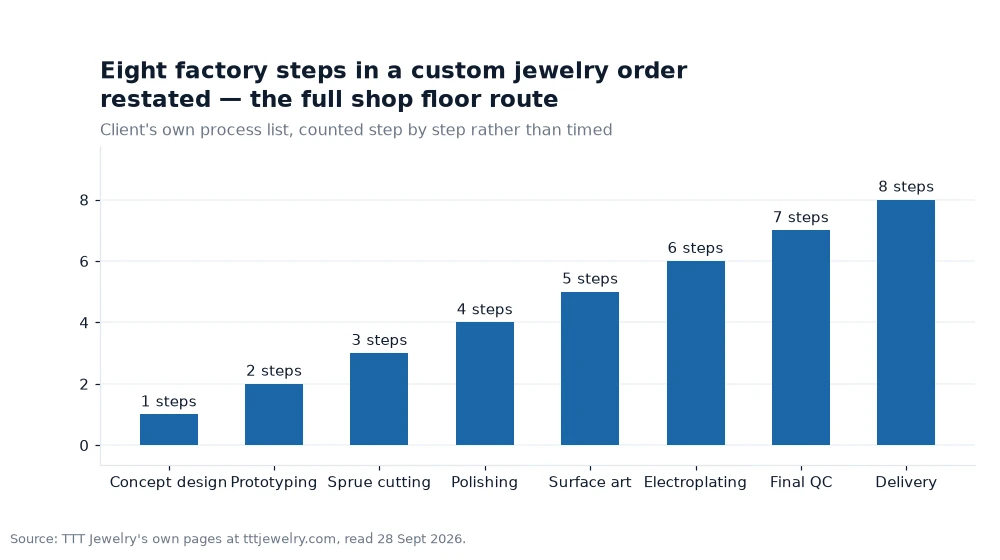
Concept design by hand and CAD, prototyping by mould or 3D printing, sprue cutting, high-gloss polishing, surface art in brushed and textured finishes, electroplating, 100% final QC and global delivery. Eight steps, one sequence, whichever model produced the drawing.
| Steps | Shop-floor work | Window |
|---|---|---|
| 1–2 | Concept design; prototyping by mould or 3D printing | CAD under 48 hours |
| 3–4 | Sprue cutting; high-gloss polishing | Inside 25–30 days sampling |
| 5–6 | Surface art; electroplating | Sampling then 21–28 days bulk |
| 7 | Final QC at 100% inspection | End of bulk |
| 8 | Delivery and global shipping | After dispatch |
Two observations follow from grouping the sequence. Steps 3 to 6 repeat identically in sampling and in bulk, which is why an approved master predicts the run so well. And step 7 covers every unit, so inspection time scales with quantity rather than with the number of designs.
Worked example
A brand plans four designs in brass. Under either model the quantity is 4 × 100 = 400 units, and inspection covers all 400.
Time the sequence. CAD is 2 days. Sampling and production together are 25–30 + 21–28 = 46–58 days. Add CAD and the programme is 48–60 days, or roughly 7 to 9 weeks. The eight-step route does not shorten because a factory developed the concept; the same benches do the same work.
Compare a mixed capsule instead. Two brass designs and two silver designs commit 200 + 100 = 300 units, because silver runs at 50 per design against brass at 100. The silver floor is 50/100 = 50% of the brass floor, so the same four shapes cost 100 fewer units when half of them move to silver.
Now compare design ownership. Under OEM, four buyer drawings produce four moulds that exist to make the buyer's IP. Under ODM, the factory's development work produces a collection exclusive to the brand, which means the exclusivity clause is doing real work rather than describing a formality.
ISO 9001:2015 documentation is the thread through both. Four designs, one approved master each, four inspection records, one delivery — an auditable chain that does not depend on which side drew the first sketch.
Frequently asked questions
What is the difference between OEM and ODM in jewelry?
Under OEM the brand supplies the design and the factory manufactures to it, with IP staying with the buyer. Under ODM the factory develops the design from the brand's direction and the resulting collection is exclusive to that brand.
Does ODM take longer than OEM?
The manufacturing windows are identical: under 48 hours for CAD, 25–30 days for sampling and 21–28 days for bulk. ODM adds concept work before the CAD stage begins, so the elapsed calendar depends on how quickly a direction is chosen.
Can a brand use both models in one collection?
Yes. Many labels run signature shapes under OEM and experimental pieces under ODM. Keep the exclusivity terms and the file ownership for each design documented separately so the two routes do not blur.
Deciding before the purchase order
Write down which side owns the drawing for every design in the range. That single line settles the model, the IP position and most of the development conversation that follows.
Brands that intend to scale quickly should look at custom jewelry wholesale terms alongside the development quote, because a design that cannot be repeated at volume is a design that will be replaced in a season.
It also pays to confirm where production sits. factory direct manufacturing means the bench that made the master is the bench that makes the run, which is the simplest way to keep a batch matching its reference.
The model is a decision about authority and ownership. The manufacturing underneath it is the same either way.
Source note: figures come from the manufacturer's own website (tttjewelry.com), read 28 Sept 2026.[1